We are only about ten days away from the release of ALL THE QUEENS’ CURSES, my debut fantasy.
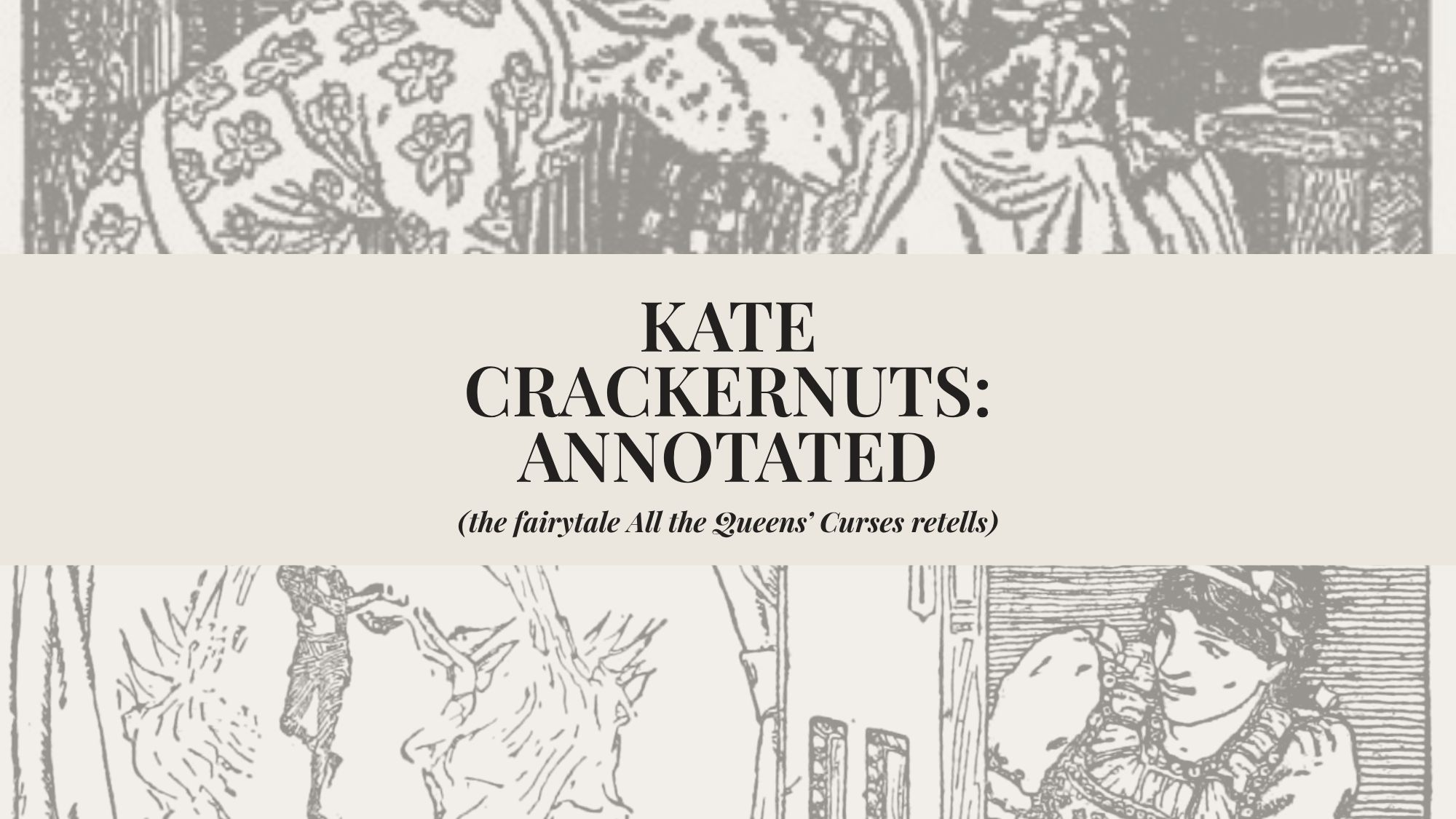
This story is based off a rare Scottish fairytale called ‘Kate Crackernuts’. Have a look at the original below. (Quite a bit changes in the book!)
The base text used here is from Joseph Jacob’s edition, originally published by David Nutt in 1898 and reprinted by Dover in 1967.
Kate Crackernuts
Once upon a time there was a king and a queen,[1] as in many lands have been. The king had a daughter, Anne,[2] and the queen had one named Kate, but Anne was far bonnier than the queen’s daughter, though they loved[3] one another like real sisters. The queen was jealous of the king’s daughter being bonnier than her own,[4] and cast about to spoil her beauty. So she took counsel of the henwife,[5] who told her to send the lassie to her next morning fasting.[6]
So next morning early, the queen said to Anne, “Go, my dear, to the henwife in the glen, and ask her for some eggs.” So Anne set out, but as she passed through the kitchen she saw a crust, and she took and munched it as she went along.
When she came to the henwife’s she asked for eggs, as she had been told to do; the henwife said to her, “Lift the lid off that pot there and see.” The lassie did so, but nothing happened. “Go home to your minnie and tell her to keep her larder door better locked,”[7] said the henwife. So she went home to the queen and told her what the henwife had said. The queen knew from this that the lassie had had something to eat, so watched the next morning and sent her away fasting; but the princess saw some country-folk picking peas by the roadside, and being very kind she spoke to them and took a handful of the peas, which she ate by the way.
When she came to the henwife’s, she said, “Lift the lid off the pot and you’ll see.” So Anne lifted the lid but nothing happened. Then the henwife was rare angry and said to Anne, “Tell your minnie the pot won’t boil if the fire’s away.”[8] So Anne went home and told the queen.
The third day the queen goes along with the girl herself to the henwife. Now, this time, when Anne lifted the lid off the pot, off falls her own pretty head, and on jumps a sheep’s head[9].
So the queen was now quite satisfied, and went back home.
Her own daughter, Kate,[10] however, took a fine linen cloth[11] and wrapped it round her sister’s head and took her by the hand and they both went out to seek their fortune. They went on, and they went on, and they went on, till they came to a castle. Kate knocked at the door and asked for a night’s lodging for herself and a sick sister. They went in and found it was a king’s castle, who had two sons, and one of them was sickening away to death[12] and no one could find out what ailed him.[13] And the curious thing was that whoever watched him at night was never seen any more.[14] So the king had offered a peck of silver to anyone who would stop up with him. Now Katie was a very brave girl, so she offered to sit up with him.[15]
Till midnight all goes well. As twelve o clock rings, however, the sick prince rises, dresses himself, and slips downstairs. Kate followed, but he didn’t seem to notice her[16]. The prince went to the stable, saddled his horse, called his hound, jumped into the saddle, and Kate leapt lightly up behind him. Away rode the prince and Kate through the greenwood, Kate, as they pass, plucking nuts from the tree[17]s and filling her apron with them. They rode on and on till they came to a green hill. The prince here drew bridle and spoke, “Open, open, green hill, and let the young prince in with his horse and his hound,” and Kate added, “and his lady him behind.”
Immediately the green hill opened and they passed in. The prince entered a magnificent hall, brightly lighted up, and many beautiful fairies surrounded the prince and led him off to the dance. Meanwhile, Kate, without being noticed, hid herself behind the door[18]. There she sees the prince dancing, and dancing, and dancing, till he could dance no longer and fell upon a couch. Then the fairies would fan him till he could rise again and go on dancing.
At last the cock crew, and the prince made all haste to get on horseback; Kate jumped up behind, and home they rode. When the morning sun rose they came in and found Kate sitting down by the fire and cracking her nuts. Kate said the prince had a good night; but she would not sit up another night unless she was to get a peck of gold[19]. The second night passed as the first had done. The prince got up at midnight and rode away to the green hill and the fairy ball, and Kate went with him, gathering nuts as they rode through the forest. This time she did not watch the prince, for she knew he would dance and dance, and dance. But she sees a fairy baby playing with a wand, and overhears one of the fairies say[20]: “Three strokes of that wand would make Kate’s sick sister as bonnie as ever she was.” So Kate rolled nuts to the fairy baby, and rolled nuts till the baby toddled after the nuts and let fall the wand, and Kate took it up and put it in her apron. And at cockcrow they rode home as before, and the moment Kate got home to her room she rushed and touched Anne three times with the wand, and the nasty sheep’s head fell off and she was her own pretty self again. The third night Kate consented to watch, only if she should marry the sick prince[21]. All went on as on the first two nights. This time the fairy baby was playing with a birdie[22]; Kate heard one of the fairies say: “Three bites of that birdie would make the sick prince as well as ever he was.” Kate rolled all the nuts she had to the fairy baby till the birdie was dropped, and Kate put it in her apron.
At cockcrow they set off again, but instead of cracking her nuts as she used to do, this time Kate plucked the feathers off and cooked the birdie. Soon there arose a very savoury smell. “Oh!” said the sick prince, “I wish I had a bite of that birdie,” so Kate gave him a bite of the birdie, and he rose up on his elbow. By-and-by he cried out again: “Oh, if I had another bite of that birdie!” so Kate gave him another bite, and he sat up on his bed. Then he said again: “Oh! if I only had a third bite of that birdie!” So Kate gave him a third bite, and he rose quite well, dressed himself, and sat down by the fire, and when the folk came in next morning they found Kate and the young prince cracking nuts together. Meanwhile his brother had seen Annie and had fallen in love with her, as everybody did who saw her sweet pretty face. So the sick son married the well sister, and the well son married the sick sister, and they all lived happy and died happy, and never drank out of a dry cappy[23].
References
Briggs, Katharine M. Kate Crackernuts. William Morrow & Company, 1980.
Jacobs, Joseph. English Fairy Tales. Dover, 1967.
Lang, Andrew. “The Story of Kate Crackernuts.” Longman’s Magazine, vol. XIII; no. LXXVIII, April 1889, pp. 660-663.
Lurie, Alison. Clever Gretchen and Other Forgotten Folktales. iUniverse, Inc., 2005.
Mayo, Margaret. Magical Tales from Many Lands. Orchard Books, 1993.
Muir, Tom. “Kate Crackernuts.” The Anthology of Scottish Folk Tales, edited by Donald Smith, The History Press, 2020, pp. 28-32.
Scottish Folk Tales. Lomond Books Ltd, 2020.
Footnotes
[1]. Tom Muir expands this to explain the king loved his first wife, but she died tragically. Katherine Briggs’s novelization also expands the backstory in this way.
[2]. The daughters’ names vary in different versions of the tale. In Andrew Lang’s version, the girls are introduced as: “The king had a dochter, Kate, and the queen had one.” After this like, it is the queen’s daughter who is always referred to as “Kate,” while the king’s daughter is not named again. This seems to have caused some confusion in the reprints.
Both daughters are called Kate by Margaret Mayo, or Katherine and Kate by Briggs. Others call the king’s daughter is Anne (Joseph Jacobs, Muir, Alison Lurie). In Lomond Books’ edition, the king’s daughter is called Princess Velvet-Cheek and the queen’s daughter is Katherine.
[3]. Jacobs relays the story primarily in past-tense, but the Lang version is in present-tense.
[4]. Some editions clarify that the queen is jealous of her step-daughter’s beauty because she wants her own daughter to marry well (Lomond Books).
[5]. Muir, Mayo, Lurie, Lamond Books, and Briggs specify that the henwife is also a witch.
[6]. Mayo clarifies this is not a bite to eat or a drop to drink. Lurie relays the command as the step-daughter must not eat anything.
[7]. Lang: “To keep her press door better steekit.” Lamond Books: “To keep the press door better snibbit.”
[8]. Mayo: “If she wants something done, she must come herself!” Some editions (Lamond Books and Lurie) do not include dialogue from this encounter, and simply say that the interaction went the same way as the previous day.
[9]. In Lamond Books’ version, Princess Velvet-Cheek picks up her own head and puts it in an egg basket.
[10]. Some editions (Lamond Books and Laurie) include a story beat where Kate sees her step-sister coming home and/or confronts her mother the queen over the transformation. In Lamond Books, Kate observes that neither she nor her sister is safe if her mother was willing to go to such lengths.
[11]. Lamond Books: “A fine shawl.”
[12]. Muir, Briggs, and Mayo have Kate discover this information while she’s working as a maid in the house. In Lang’s version, Kate is given housing on the condition that she watches the prince. In Lamond Books, Kate is asked specifically to help the ailing prince because she has experience with her sick sister.
[13]. In Lamond Books version, “a strange disease, which seemed to have touched his brain . . . Someone had always to be with him to watch that he did himself no harm.”
[14]. Detail excluded from Lang’s version.
[15]. In Lurie’s version, Kate has hidden herself in the room so that the prince does not know she is there.
[16]. Lurie: “He walked as if in a dream.” Mayo: “In a daze.” Briggs: “There was a glazed and flightless look in [his eyes].”
[17]. Some versions (Lamond Books) do not clarify that she picks nuts as they ride.
[18]. In Mayo’s version, Kate realizes she is in the hall of the fairy folk and if they catch her spying they will never let her go.
[19]. In Lamond Books, the king offers her a bag of gold Bonnet-pieces.
[20]. In Lang and the Lamond Books’ versions, this happens on the first night she’s there.
[21]. Mayo has Kate ask for this after the prince has been healed. Lamond Books has the king order the marriage after the prince has been healed.
[22]. In Lamond Books, this happens on the second visit.
[23]. Lurie: “They lived happily together ever after.” Lamond Books: “And, unless they be dead since then, the young couples are living yet.”